Garrett Hardin Reading "the Tragedy of the Commons"

"Freedom in a commons brings ruin to all."
"The maximum is non the optimum."
"We tin't cure a shortage by increasing the supply."
"Birth control does not equal population control."
"Exponential growth is kept under control by misery."
– Garrett Hardin
Garrett Hardin (1915-2003) was a respected ecologist and philosopher who warned on the dangers of overpopulation. He wrote a famous 1968 paper titled "The Tragedy of the Commons" which you tin can download or view in full here. More information on Garrett's accomplishments and beliefs can be plant at the Garrett Hardin Order site.
The fundamental idea of the tragedy of the eatables is that the collective issue of individuals making contained, well-intentioned, rational decisions regarding the use of a shared resources, leads to the degradation of the resource such that it can no longer support the individuals that depend upon it.
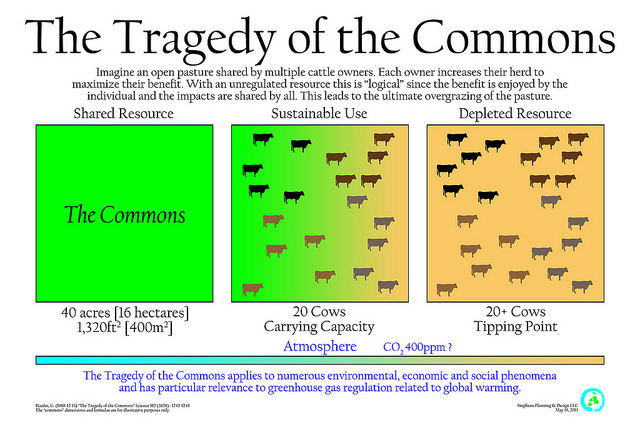
The classic example, and ane nosotros take repeated many times since we came to depend on agriculture 10,000 year agone, is the overgrazing of a pasture shared past herdsman.
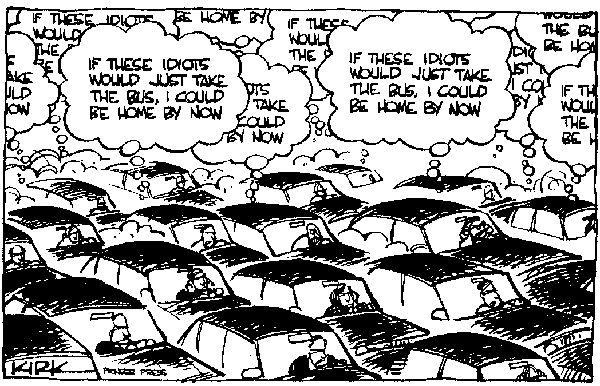
A more than modern instance is someone who emits big quantities of CO2 into the atmospheric commons by flying long distances on a regular basis to spend quality time with family unit members whose lives volition before long be harmed by climate change.
I was familiar with the concept of the tragedy of the eatables only I was not aware that Garrett Hardin was the offset modern scientist to write on the topic until a friend recently brought his paper to my attending. I read the paper, learned quite a bit, and recommend it to others.
I was specially impressed with Hardin's articulate and direct thinking on the threat of over-population and what must be done to prevent it. Here are a few noteworthy excerpts from his essay.
The tragedy of the commons is involved in population problems in another style. In a globe governed solely by the principle of "dog swallow dog"–if indeed at that place ever was such a world–how many children a family had would not be a matter of public concern. Parents who bred too exuberantly would get out fewer descendants, not more, considering they would be unable to care adequately for their children. David Lack and others have found that such a negative feedback demonstrably controls the fecundity of birds. Simply men are non birds, and accept non acted like them for millenniums, at least.
If each human family were dependent only on its own resources; if the children of extravagant parents starved to decease; if, thus, overbreeding brought its own "punishment" to the germ line–then at that place would be no public interest in decision-making the breeding of families. Simply our gild is deeply committed to the welfare country, and hence is confronted with another aspect of the tragedy of the commons.
In a welfare state, how shall we deal with the family, the faith, the race, or the class (or indeed any distinguishable and cohesive group) that adopts overbreeding as a policy to secure its own aggrandizement? To couple the concept of liberty to breed with the belief that everyone born has an equal right to the commons is to lock the globe into a tragic course of action.
Unfortunately this is merely the course of action that is beingness pursued past the United Nations. In late 1967, some 30 nations agreed to the following:
The Universal Declaration of Human Rights describes the family unit every bit the natural and fundamental unit of order. Information technology follows that any choice and decision with regard to the size of the family must irrevocably rest with the family unit itself, and cannot exist fabricated past anyone else.
Information technology is painful to have to deny categorically the validity of this right; denying it, one feels as uncomfortable as a resident of Salem, Massachusetts, who denied the reality of witches in the 17th century. At the nowadays fourth dimension, in liberal quarters, something like a taboo acts to inhibit criticism of the Un. There is a feeling that the Un is "our last and best hope," that we shouldn't observe fault with information technology; we shouldn't play into the easily of the archconservatives. Nonetheless, let united states of america not forget what Robert Louis Stevenson said: "The truth that is suppressed by friends is the readiest weapon of the enemy." If we beloved the truth we must openly deny the validity of the Universal Declaration of Human Rights, even though it is promoted past the United Nations.
Information technology is a mistake to think that we can command the convenance of mankind in the long run by an appeal to conscience. Charles Galton Darwin fabricated this point when he spoke on the centennial of the publication of his grandfather's bang-up book. The argument is straightforward and Darwinian.
People vary. Confronted with appeals to limit breeding, some people will undoubtedly respond to the plea more than others. Those who have more than children will produce a larger fraction of the next generation than those with more susceptible consciences. The difference will be accentuated, generation by generation.
In C. G. Darwin's words: "It may well be that information technology would take hundreds of generations for the progenitive instinct to develop in this style, just if it should do so, nature would have taken her revenge, and the variety Homo contracipiens would become extinct and would be replaced by the variety Human being progenitivus".
Possibly the simplest summary of this analysis of man'southward population problems is this: the commons, if justifiable at all, is justifiable just nether weather condition of low-population density. Equally the human population has increased, the commons has had to be abased in one aspect afterward another.
The most important aspect of necessity that we must at present recognize, is the necessity of abandoning the eatables in convenance. No technical solution tin can rescue us from the misery of overpopulation. Liberty to breed will bring ruin to all. At the moment, to avoid hard decisions many of us are tempted to propagandize for censor and responsible parenthood. The temptation must be resisted, because an appeal to independently interim consciences selects for the disappearance of all conscience in the long run, and an increment in anxiety in the brusk.
The only manner nosotros tin can preserve and nurture other and more than precious freedoms is past relinquishing the freedom to breed, and that very presently. "Liberty is the recognition of necessity"–and it is the role of teaching to reveal to all the necessity of abandoning the freedom to breed. Only then, can we put an stop to this aspect of the tragedy of the commons.
I summarize Hardin'southward position as follows:
- Failure to control population growth will effect in ruin.
- Population control via appeal to reason or conscience, or threat of shame, will not work, and volition in fact make the situation worse. Population can but be effectively controlled by compulsion, that is, laws with penalties for overbreeding.
- The key to passing population control laws is to educate citizens on the reality that if they practise not relinquish the freedom to breed they volition lose all of their freedoms, including somewhen the freedom to breed.
Garrett Hardin was a wise and prescient man who attempted to warn his swain citizens of a serious threat to their well existence, and most importantly, told them what they needed to do and why. Other peachy people have attempted to do the same, for example, Dennis Meadows and his collaborators on the 1972 Limits to Growth study.
Hardin's essay was written 50 years ago when the world's population was iii.5 billion, a level already far in backlog of what can be sustained without abundant, affordable, not-renewable, finite, and depleting fossil energy.
Over the last 50 years the population more doubled to 7.six billion and many new overshoot threats backed by solid scientific agreement have emerged like climate change, net energy decline, and ground level ozone.
There's been plenty of information and (opportunity for) education. Nosotros can therefore conclude that Hardin's assumption that didactics is the key to preventing overshoot is wrong.
As readers of this blog know, I think the key impediment to changing human behavior in a positive direction is the fact that humans evolved to denial reality, as explained by Varki'southward MORT theory.
How can a majority emerge to support a contentious law to control breeding when the vast bulk of the 7.6 billion people on the planet deny the existence of overshoot?
Much has been written by many people on the tragedy of the eatables. Commentators typically autumn into i of two groups:
The first group appreciates the centrality of the commons trouble to human existence and spends much energy arguing how all-time to address the trouble with the usual divisive, inconclusive, and unproductive positions of correct vs. left, private vs. public, capitalism vs. socialism, libertarian vs. autocratic , etc.
The 2nd group denies a commons trouble exists, or thinks innovation and applied science will solve any problems.
Where is the most important and missing third group?
That would be the group searching for an understanding of how an otherwise uniquely intelligent species can deny its obvious predicament. Brief reflection leads to the obvious conclusion that until nosotros understand the genetic ground for our ability, on the one mitt, to understand highly complex topics, similar the laws of physics that explain the creation of the universe and life, and on the other paw, to selectively deny much simpler and evidently obvious facts, like human overshoot and our own mortality, we accept no hope of addressing the tragedy of the commons, or whatsoever of the other behaviors that threaten our species.
A few people have achieved some insight into our tendency to deny reality but I observe that they usually soon thereafter drib their pursuit of understanding. I find this very curious considering if you take a deep understanding of the human predicament there is nothing more import to understand and to raise awareness of than reality denial.
If you deny the existence or implications of overshoot, then it is logical to comprehend ane or more than of the many arguments against a one child law, thrift, and conservation. On the other manus, if you comprehend the reality of overshoot, then a one kid police, austerity, and conservation not simply go perfectly reasonable, they become the virtually important, upstanding, moral, and rational things we must practice.
There is an exciting (for me) passage in Hardin'south essay that hints he may have understood or predictable at least a portion of the MORT theory.
…the rational herdsman concludes that the just sensible course for him to pursue is to add some other fauna to his herd. And another; and another… Only this is the conclusion reached by each and every rational herdsman sharing a commons. Therein is the tragedy. Each human is locked into a system that compels him to increase his herd without limit–in a world that is limited. Ruin is the destination toward which all men rush, each pursuing his own all-time involvement in a social club that believes in the freedom of the eatables. Freedom in a commons brings ruin to all.
Some would say that this is a platitude. Would that it were! In a sense, it was learned thousands of years ago, just natural pick favors the forces of psychological denial (8). The individual benefits equally an individual from his ability to deny the truth fifty-fifty though society as a whole, of which he is a part, suffers.
Education tin counteract the natural tendency to do the wrong thing, but the inexorable succession of generations requires that the basis for this knowledge be constantly refreshed.
Hardin demonstrated a flash of deprival insight by correctly identifying the key issue, but and so neglected to explore further in his tragedy of the commons essay. Unfortunately the reference for his annotate on denial is the volume "Population, Development, and Birth Control", which is a collection of essays by different authors that Hardin published in 1964, in which Hardin himself contributed an essay titled "Denial and the Gift of History", and is not available on the net. I would be grateful if a reader has a hard copy of this book and would be kind enough to provide a summary of his essay.
My expectation is that Hardin did non elaborate on deprival of reality because at that place was ample opportunity for him to practise so in his other books, papers, and interviews that I downloaded and searched.
I did detect this ane excerpt from an interview but it is not very insightful and he clearly thinks the solution is more pedagogy:
RUSSELL: Okay. The idea of statistics and the population–I take no reason to actually go over that. The other 1, of denial and the gift of history, which was a fascinating idea. Our view of working at it, our immortality.
HARDIN: Yes. Well, I think everybody, as he grows older and accumulates more experience and more than observation of other people–of himself, also–is impressed with how oft we try to fool ourselves. It'southward an inescapable homo tendency. This is part of original sin, trying to fool ourselves, and always to make things look better than they are. The question is, since we're so ingenious at pulling the wool over our own optics, what reverse measures can be taken? It seemed to me that this is 1 of the great apologies for teaching history: when yous see other people in the by, people with whom y'all accept no connexion, making the same mistakes, then yous can, I retrieve, be more objective most yourself, and say, "Well, perchance I'm only repeating what this guy did ii- or iii-hundred years agone." And this, I think, is 1 of the nifty gifts of history. It gives us long arms for holding instructive examples far plenty from our eyes.
A search also suggested that no 1 else in 50 years thought Hardin'southward comment on reality denial was worth discussing. Many people saw and run into merit in Hardin's piece of work, just all seem to have missed his most important point, including maybe Hardin himself.
I also note that Ajit Varki, the merely surviving writer of the MORT theory, is no longer researching, or attempting to spread sensation of his theory. Varki is instead leading some research on Glycobiology, which with time, will show to be insignificant compared to MORT.
Because nosotros understand the dangers, we exercise not permit alcoholics, or epileptics, or schizophrenics, or bullheaded people to fly our planes.
If we understood our genetic tendency to deny reality, we might non permit reality deniers, which by the manner are very like shooting fish in a barrel to find, to run for elected office.
Many impressive scientists and leaders are working hard to shift the needle on human overshoot. All take failed, and all will proceed to fail, if they practise not embrace the MORT theory.
We demand some scientists and leaders of stature to step up and push button awareness of the MORT theory.
A cranky old retired electric engineer writing a weblog doesn't cut it.
Information technology is too late to avoid a lot of suffering, but with sensation of our predicament nosotros could reduce future suffering, and nosotros might avoid harmful emotional reactions like nuclear war or revolutions.
If we have a hope, MORT sensation might be our only promise.
Source: https://un-denial.com/2018/01/07/on-garrett-hardins-tragedy-of-the-commons/
0 Response to "Garrett Hardin Reading "the Tragedy of the Commons""
Post a Comment